The placement assistance meaning is simple: an institute helps you prepare for jobs and connects you with chances, but it does not promise that you will get one. A placement guarantee is a different claim, and it should make you careful. This article explains what honest placement assistance includes, what it does not, and the questions to ask before you join any course.
Key Takeaways
- Placement assistance means support such as guidance, interview preparation and help with documents. It is not a promise of a job.
- The employer makes the hiring decision, not the institute.
- Be careful of phrases like “100% placement” or “guaranteed Gulf job”.
- Ask for written terms about what is included and what is not.
- Your own skill, discipline and documents decide most of the outcome.
What is the placement assistance meaning in a training institute?
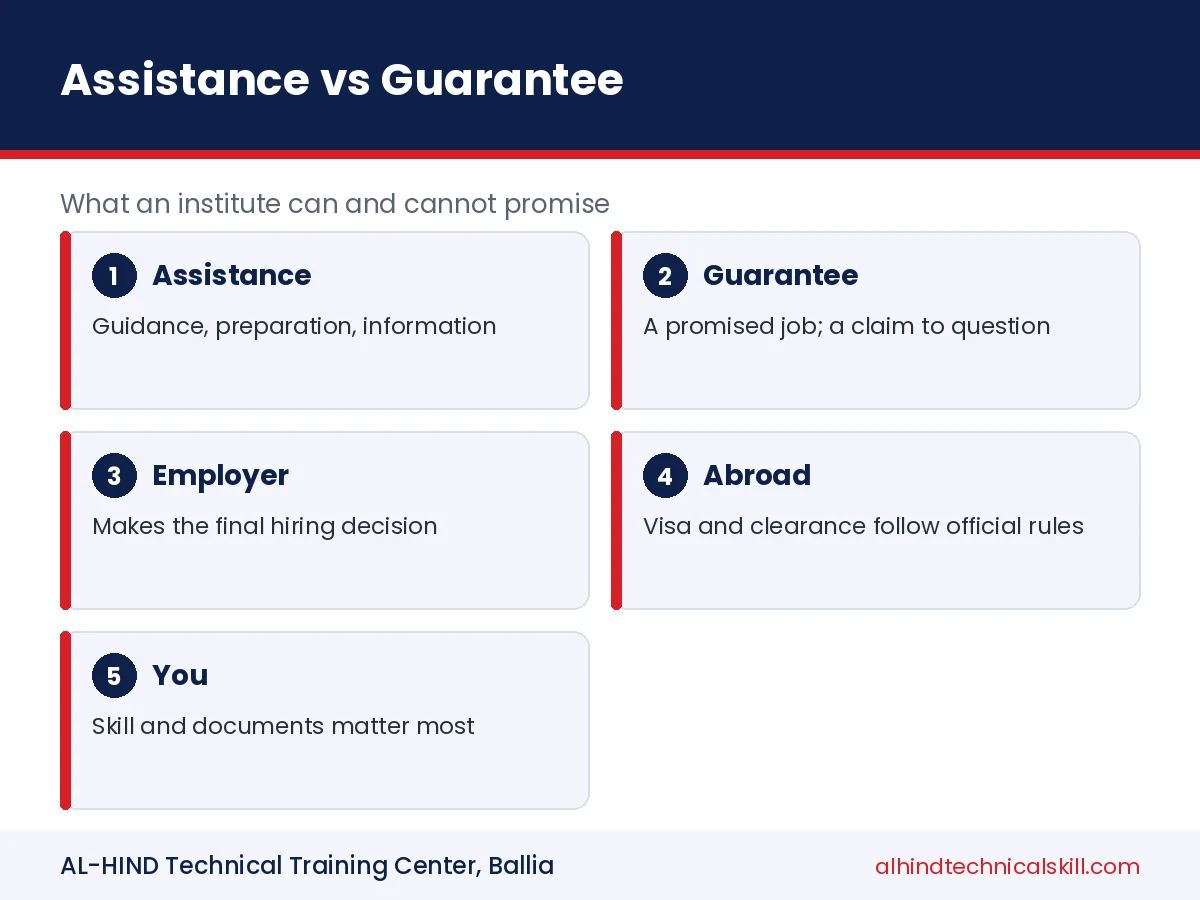
Placement assistance means the institute supports your job search after or during training. It does not mean the institute is the employer, and it does not mean a job is certain. Honest support may include career counselling, CV or resume help, interview practice, advice on documents, and sharing job information when it is available.
In technical trades, it can also mean helping you understand how Gulf hiring works: trade tests, medicals, contracts and the government clearance process. This is guidance. The decision always rests with the employer and, for foreign work, with the rules of the government and the destination country.
How is placement assistance different from a placement guarantee?
A guarantee is a promise of an outcome. Assistance is a promise of effort and support. No institute controls company hiring, visas, medicals or government rules, so it cannot honestly promise a result.
| Point | Placement assistance | Placement guarantee claim |
|---|---|---|
| What is promised | Support, guidance, preparation | A job for sure |
| Who decides hiring | The employer | The claim says the institute |
| Can the institute control it? | Only its own support | No, so the claim is risky |
| What to expect in writing | List of services offered | Often vague or missing |
| Typical risk | Low if services are real | High; may be a sales trick |
For foreign jobs, a guarantee is even riskier because visas and clearances are not in the institute’s control. Read more on our placement assistance page and learn how to spot problems in fake Gulf job offers.
What can a good institute actually help you with?
The useful parts are practical. Check whether the institute can really do each one.
Before you get a job
- Hands-on training on real tools with a trainer present.
- Basic English or communication practice for interviews.
- Trade test practice, as explained in our Gulf trade test guide.
- Guidance on documents, as in documents required for Gulf jobs.
- Mock interviews with questions from Gulf job interview questions for technicians.
When an opportunity appears
The institute may share job information, introduce you to genuine contacts and explain the offer. You still need to read the contract yourself and verify the agent and the employer.
Which claims should make you careful?
Slow down when you see strong promises or pressure. These are common patterns:
- “100% job guarantee” or “direct visa guaranteed”.
- Large payment demanded before any written terms.
- Cash only, no receipt.
- A certificate promised only for money, with no training.
- Pressure such as “last seat today”.
- Refusal to say which employer or agent will be used.
If the job is abroad, the agent must be registered. The Ministry of External Affairs overview of overseas employment explains that no person or agency may work as a recruiting agent without a valid certificate, and the eMigrate portal lists registered agents. Our guide to checking a Gulf recruitment agent gives more checks.

What questions should you ask before joining a course?
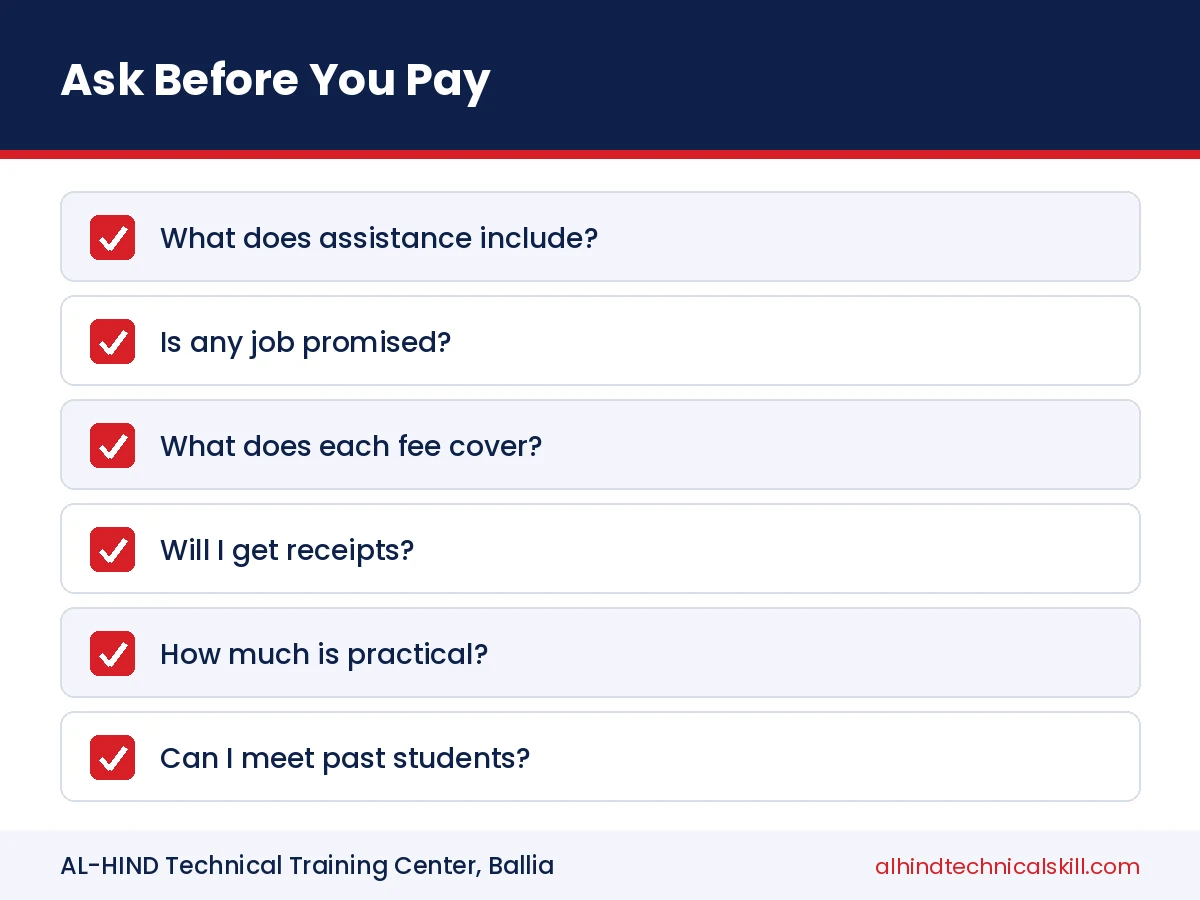
Write these down and ask them on a visit. A good institute will answer calmly and in writing.
- What exactly is included in placement assistance?
- Is any job guaranteed? Please write that down.
- What are the fees, and what does each fee cover?
- Will I get a receipt for every payment?
- How many hours are practical, and on which tools?
- What happens if I cannot complete the course?
- Do you charge anything extra when a job comes through an agent?
- Can I speak to former students?
Keep the answers. If the answers change later, you have proof.
What can you do to improve your own chances?
Most of the result depends on you. Think of placement assistance as a ladder, not a lift, and keep its meaning clear. Learn the trade well, show up on time, keep notes of the jobs you complete and look after your documents. Learn safety rules, because employers value people who work safely.
Build a small portfolio: a notebook of tasks done under supervision, photos where allowed, and references from trainers. Keep your passport, certificates and photographs in one folder. If you want to work abroad, learn the official steps so no agent can fool you. Our guide to technical training and Gulf jobs in Ballia explains how training and the Gulf process connect.
Why learn at Al-Hind Technical Training Center?
Al-Hind provides practical trade training at its Ballia centre, with counselling and help in understanding the Gulf job process. Our promise is honest support: we offer placement assistance and guidance, not a guaranteed job or visa, and we will tell you plainly what we can and cannot do. You can read our placement page, view courses or visit the about page to understand the centre before you decide.
Frequently asked questions
What is the placement assistance meaning in simple words?
It means the institute helps you with job preparation and connects you with opportunities when available, but does not promise a job. Support can include counselling, interview practice and document guidance. The employer decides who is hired.
Is placement assistance the same as a job guarantee?
No. Assistance is support and effort. A guarantee is a promise of a result that an institute usually cannot control. Treat any promise of a sure job, especially abroad, with caution and ask for it in writing.
Should I pay extra for placement?
Ask exactly what the payment covers and get it in writing with a receipt. Be careful of fees that are linked to a promised job, especially for foreign work. For overseas jobs, check lawful charges with official sources and registered agents.
How do I know if a placement claim is fake?
Warning signs include a 100 percent guarantee, no written terms, cash-only payment, pressure to pay quickly and refusal to name the employer or agent. Verify the agent on the official portal and talk to former students.
Can an institute guarantee a Gulf job?
No. Gulf hiring depends on employers, visas, medical checks and government rules that an institute does not control. A genuine institute can offer training, guidance and information, but not a guaranteed job or visa.
What should I ask before joining a technical course?
Ask what is included, the total fee and what each part covers, how much practical training you get, whether any job guarantee is made, and what happens if you leave. Get the answers in writing and keep every receipt.
Conclusion
Understanding the placement assistance meaning protects your money and your plans: help and guidance are real value, but a guaranteed job is not something any honest institute can sell. Ask clear questions, read the paperwork and build your skill.
Want a straight answer about training and support? Call or WhatsApp 7393017040 or 7860262615, or visit the centre at Umargang Gawar Road, near Bank of Baroda, Ballia, Uttar Pradesh 277001.