An electrician course syllabus usually covers electrical basics, safety rules, tools and meters, house wiring, earthing and protection devices, motors, fault finding and reading simple circuit diagrams. Good courses teach these topics through hands-on practice, not only theory, so you can work on real boards by the end.
Key Takeaways
- Most electrician courses start with basics and safety, then move to wiring, motors and fault finding.
- Practical work on wiring boards is the most important part of the syllabus.
- Always ask the centre for the exact topic list, duration and eligibility in writing.
- Safety training is part of the syllabus, not an extra.
- Gulf employers often test trade skill, so practice matters more than notes.
What is an electrician course syllabus?
A syllabus is the list of topics a course teaches, in the order you learn them. For an electrician course, it starts with simple ideas such as voltage and current and ends with real work such as wiring a board or finding a fault in a circuit.
Different centres arrange topics a little differently. The list below shows the core areas that most practical electrician courses cover. Exact subjects, duration and eligibility can change, so please confirm them with the centre before you join. You can read the Al-Hind course overview on our electrician course in Ballia page.
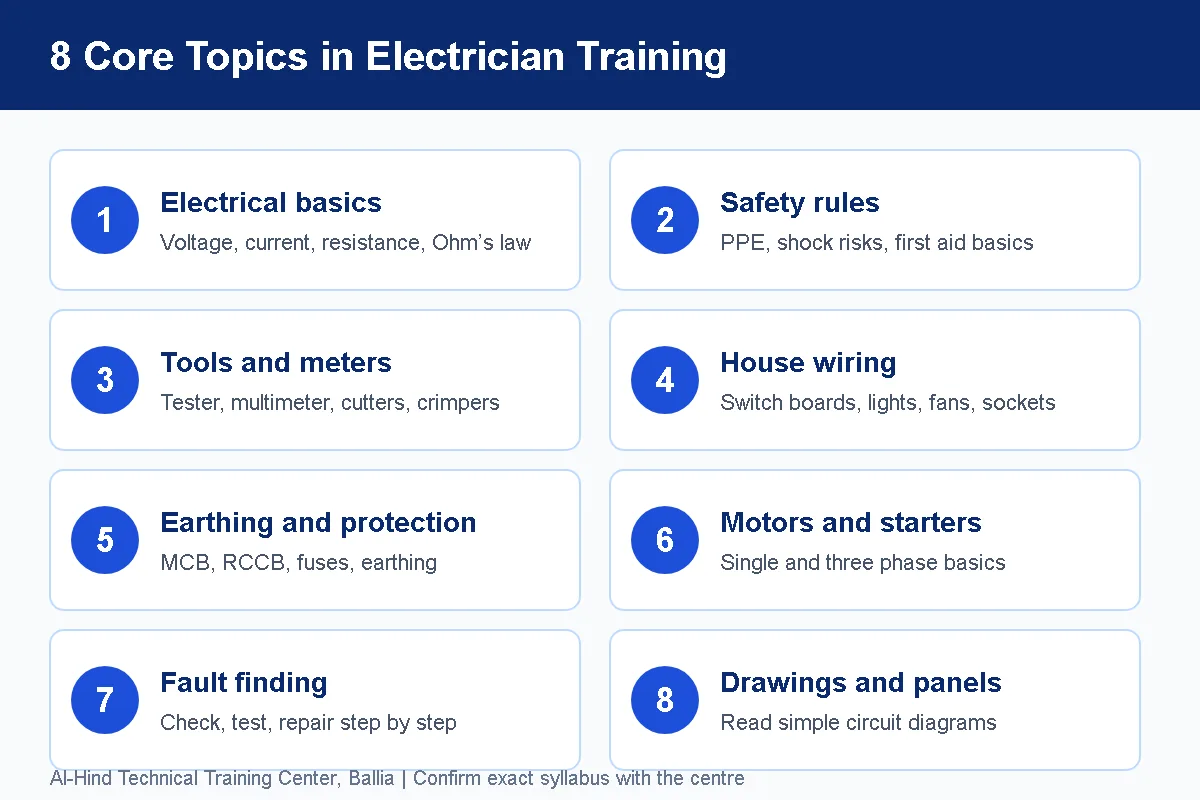
Which topics do you learn in an electrician course?
Think of the syllabus as eight building blocks. Each block gives you a skill that the next block needs.
| Topic | What you study | Why it matters on the job |
|---|---|---|
| Electrical basics | Voltage, current, resistance, Ohm’s law, AC and DC | You cannot find a fault if you do not understand how current flows |
| Safety rules | PPE, shock risks, lockout steps, first aid basics | Most site accidents are avoidable with simple habits |
| Tools and meters | Tester, multimeter, pliers, cutters, crimping tools | Right tool use saves time and prevents damage |
| House wiring | Switch boards, lights, fans, sockets, circuit layout | This is the daily work of a wireman or domestic electrician |
| Earthing and protection | MCB, RCCB, fuses, earthing methods | Protection devices stop shocks and fires |
| Motors and starters | Single phase and three phase motors, simple starters | Many industrial jobs involve motor work |
| Fault finding | Testing circuits, finding open and short circuits | Employers value people who can repair quickly |
| Drawings and panels | Reading simple diagrams, panel wiring basics | Needed for site and plant work |
Why is practical work the most important part?
Reading about a circuit is not the same as wiring one. In a practical class you cut wires, strip insulation, tighten terminals and test your own connection. Mistakes in the workshop cost nothing, but the same mistake on a site can be costly or dangerous.
When you compare institutes, ask how many hours go to workshop practice and how many students share one board. A syllabus on paper means little if there is no board to practise on.

How does a typical learning path look?
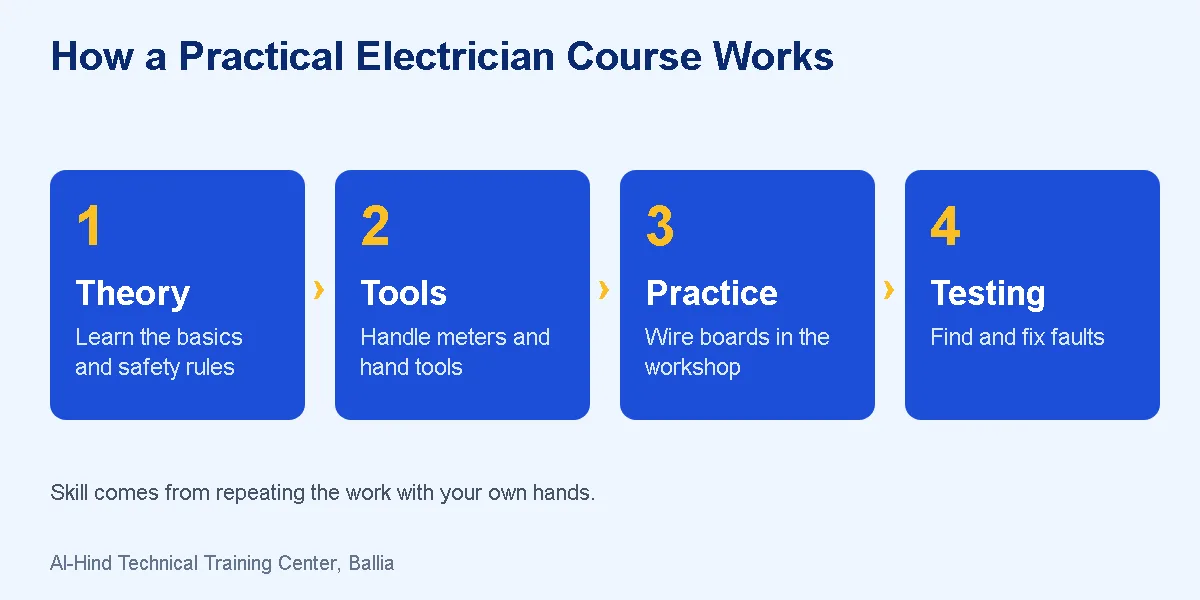
Most practical courses follow four stages. You can use these steps as a checklist when you visit a centre.
- Learn the theory and safety rules in simple language.
- Get to know each tool and meter, and practise reading values.
- Wire practice boards in the workshop, from simple to complex.
- Test your work, create faults on purpose, and learn to fix them.
How does the syllabus connect to jobs in India and the Gulf?
Employers look for people who can read a simple diagram, wire safely and repair faults. Many Gulf employers also ask for a trade test or an interview in which you explain your work. Our guide on the Gulf trade test explains what such tests usually check.
For national skill standards and approved job roles, you can visit the official National Skill Development Corporation (NSDC) and Skill India Digital websites. If you plan to work abroad, always register and check agents on the eMigrate portal of the Ministry of External Affairs.
No course can promise a job. A good syllabus gives you skills, and your practice, discipline and honest paperwork do the rest. Read our electrical safety rules for electricians to see how seriously safety should be taken from day one.
Why learn at Al-Hind Technical Training Center?
- Over 15 years of experience in technical training.
- ISO 9001:2015 certified institute.
- Practical training in Electrician, HVAC/AC Technician, Pipe Fitter and Safety courses.
- Placement assistance for Saudi Arabia, UAE, Qatar, Oman and Bahrain (assistance only, not a job guarantee).
- Easy to visit: Umarganj, Garwar Road, Near Bank of Baroda, Ballia, U.P. 277001.
Want to know the exact syllabus, duration, eligibility and fees? Please ask the centre directly, because these details are not listed online. See the full course list or find us on the location page.
Frequently asked questions
What is taught in an electrician course?
An electrician course usually teaches electrical basics, safety rules, tools and meters, house wiring, earthing and protection devices, motors, fault finding and simple diagrams. Practical workshop time is a big part of the course. Ask the centre for its exact topic list.
Is electrician course syllabus the same in every institute?
No. The core ideas are similar, but each institute may arrange topics, hours and practical work differently. That is why you should ask for the syllabus in writing and compare how much time goes to workshop practice before you decide.
Do I need to know physics before joining?
You do not need advanced physics. Simple ideas such as voltage, current and resistance are taught from the start. Eligibility rules differ by centre, so please call and confirm the education level needed for the course you want.
Does an electrician course include safety training?
A good course includes safety from the first week. You learn protective equipment, shock risks, safe isolation and basic first aid. Safety is not an extra topic, because it protects you and everyone around you on every job.
Can an electrician course help me get a job abroad?
Skills help, but no centre can promise a job. Gulf employers often check your trade skill, papers and interview answers. Al-Hind offers placement assistance, and you should always verify agents on the official eMigrate portal.
How can I ask Al-Hind about the course?
You can call or WhatsApp 7393017040, or visit the centre at Umarganj, Garwar Road, Near Bank of Baroda, Ballia. Ask for the syllabus, duration, eligibility and fees, and request them in writing before you pay anything.
Conclusion
A good electrician course syllabus moves from basics and safety to wiring, motors and fault finding, with plenty of hands-on practice. Compare centres on practical hours, not only on topic lists, and keep every promise in writing.
Ready to learn? Call or WhatsApp 7393017040, or visit Al-Hind Technical Training Center at Umarganj, Garwar Road, Near Bank of Baroda, Ballia. Website: alhindtechnicalskill.com.
By Al-Hind Technical Training Center Team | Last updated: 26 October 2026