To work in the Gulf as a technician, you need a valid passport, a trade skill, a registered recruiting agent, a written contract, the correct employment visa and, if your passport is ECR, emigration clearance. Follow the steps in order and keep every paper and receipt safe.
Key Takeaways
- The process has eight clear steps, from passport check to departure.
- All six Gulf countries are on the ECR list, so check your passport status first.
- Use only recruiting agents registered on the eMigrate portal.
- Ask for a written contract in English and a receipt for every payment.
- No agent or institute can honestly guarantee a job.
What is the process to work in the Gulf?
The process is simple to remember if you split it into small steps. Each step protects you from a common problem, such as fake visas, wrong visa type or unpaid promised salary. The chart below shows the full path.
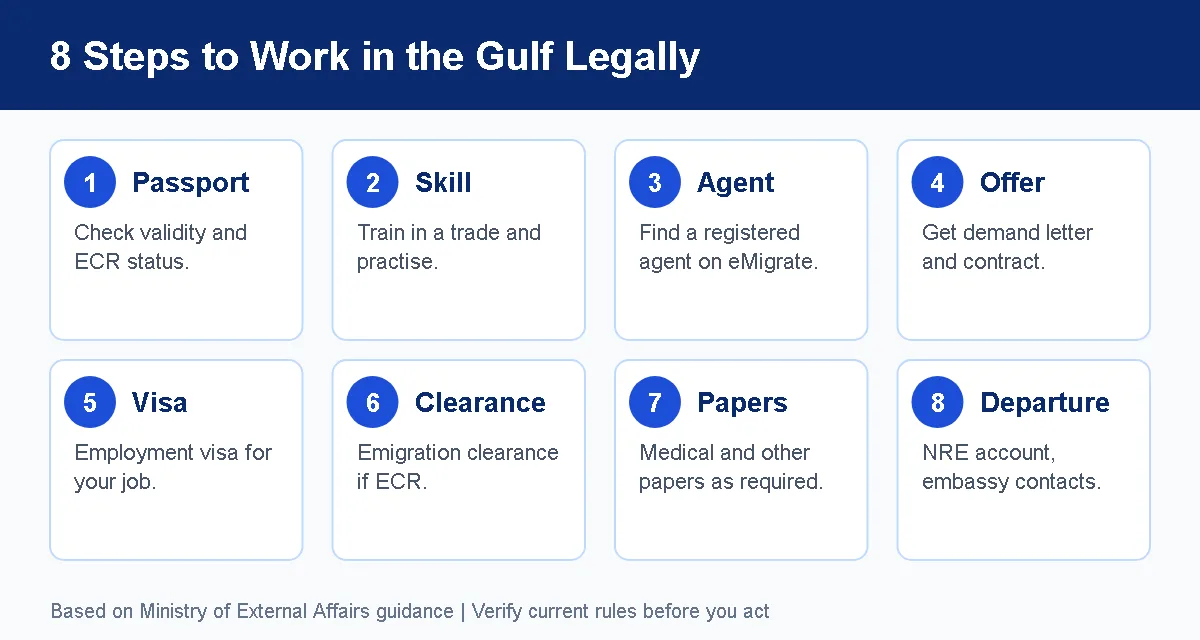
Step by step: how do you go from training to a Gulf job?
- Check your passport. It should be valid for at least six months and have blank pages. Find out if it is ECR or ECNR.
- Build a trade skill. Join a practical course such as electrician, HVAC, pipe fitter or safety, and practise on real work.
- Find a registered agent. Search the agent on the eMigrate portal and ask to see the registration certificate.
- Get the offer in writing. Ask for the employer’s demand letter and a signed contract in English.
- Confirm the visa type. It must be an employment visa that matches your job, not a visit visa.
- Get emigration clearance if needed. ECR passport holders going for employment need clearance from the Protector of Emigrants.
- Complete required papers. Medical tests, police clearance and trade tests are asked for by some employers and countries. Confirm what applies to you.
- Prepare for departure. Open an NRE savings account, learn local labour rules and note the Indian embassy address and phone number.
These points follow the Ministry of External Affairs guide, Emigration for Overseas Employment. Rules can change, so always check the official site before you act.
What is the difference between ECR and ECNR passports?
ECR means Emigration Check Required. Persons with an ECR passport who go to an ECR country for employment need emigration clearance. ECNR means Emigration Check Not Required. People with matriculation (Class 10) and above are generally exempt from ECR, but your own passport status is what counts, so check it.
| Point | ECR passport | ECNR passport |
|---|---|---|
| Meaning | Emigration check required | Emigration check not required |
| Going to an ECR country for a job | Emigration clearance needed | Clearance not needed |
| Where to check | Passport and Protector of Emigrants office | Passport and official MEA information |
How do you avoid fake agents and fake visas?
Fraud is the biggest danger in this process. MEA advises you not to deal with sub-agents and not to pay more than the amount allowed under the rules. As per the MEA guide, the service fee limit is 45 days of wages under the contract, with a maximum of Rs 30,000. Because rules can be updated, confirm the current limit on the official site.

Pay by cheque, demand draft or electronic transfer, not cash in hand, and always take a receipt. If something goes wrong, you can call the Pravasi Bharatiya Sahayata Kendra helpline 1800-11-3090. Read our guide on how to check if a Gulf agent is genuine for more tips.
Which papers and tests should you prepare?
Keep copies of your passport, photographs, education and training certificates, experience letters and the signed contract. Our post on documents required for Gulf jobs lists them in detail. If your employer asks for a trade test, read the Gulf trade test guide. To compare countries, see the country-by-country guide for technicians.
Why learn at Al-Hind Technical Training Center?
- Over 15 years of experience in technical training.
- ISO 9001:2015 certified institute.
- Practical courses: Electrician, HVAC/AC Technician, Pipe Fitter and Safety, plus international safety certification (NEBOSH, IOSH, OSHA).
- Placement assistance for Saudi Arabia, UAE, Qatar, Oman and Bahrain, which is assistance and not a job guarantee.
- Address: Umarganj, Garwar Road, Near Bank of Baroda, Ballia, U.P. 277001.
Explore our courses or visit the location page to plan a visit.
Frequently asked questions
What is the first step to work in the Gulf?
Check your passport first. It should be valid for at least six months and have blank pages. Then find out if it is ECR or ECNR, because that decides whether you need emigration clearance when you go for a job.
Do I need emigration clearance for the Gulf?
If your passport is ECR and you go to an ECR country for employment, you need emigration clearance from the Protector of Emigrants. People whose passports are ECNR do not need it. Check your passport and the official MEA guidance.
How can I check a recruiting agent on eMigrate?
Visit the official eMigrate portal and look for the agent in the registered recruiting agents list. Ask the agent to show the original registration certificate, and do not deal with anyone whose registration is invalid or cancelled.
Is a visit visa safe for a Gulf job?
No. A visit visa is not meant for employment, and working on it can create legal trouble. Make sure you receive an employment visa that matches the job described in your written contract before you travel.
How much can an agent charge for a Gulf job?
According to the MEA guide, an agent should not charge more than 45 days of wages under the contract, with a maximum of Rs 30,000, and must give a receipt. Rules can change, so confirm the current limit on the official portal.
Can Al-Hind guarantee a Gulf job after training?
No. Al-Hind offers training and placement assistance for Gulf countries, but selection depends on the employer. Be careful of anyone who guarantees a job. Call or WhatsApp 7393017040 to ask about courses and how assistance works.
Conclusion
The process to work in the Gulf is clear when you follow it step by step: check your passport, build a skill, use a registered agent, read the contract, confirm the visa and complete required clearances. Skipping a step is what causes most problems.
Need help planning? Call or WhatsApp 7393017040, or visit Al-Hind Technical Training Center, Umarganj, Garwar Road, Near Bank of Baroda, Ballia. Website: alhindtechnicalskill.com.
By Al-Hind Technical Training Center Team | Last updated: 26 October 2026