How air conditioner works comes down to one idea: it does not make cold, it moves heat from inside your room to the outside using a refrigerant that goes round in a closed loop. Four main parts do the job: the compressor, the condenser, the expansion device and the evaporator. Once you understand this refrigeration cycle, most AC faults become easier to think about.
Key Takeaways
- An AC moves heat out of the room; it does not create cold.
- The loop has four main parts: compressor, condenser, expansion device and evaporator.
- Refrigerant changes between liquid and gas to carry heat.
- Many problems come from dirty filters, low airflow or electrical faults, not only from gas.
- Refrigerant work and live electrical work should be done only by trained people under a qualified supervisor.
How air conditioner works: what is the simple explanation?
Think of a wet cloth on your skin. When water on it dries, you feel cool because evaporating liquid takes heat from your body. An AC uses the same effect, but with a refrigerant inside sealed copper pipes. Inside the room unit, the liquid refrigerant turns into gas and takes heat from the room air. Outside, the gas is squeezed and cooled so it turns back into liquid, giving that heat to the outside air. Then the cycle repeats again and again.
A fan in the indoor unit blows room air across cold coils. The air loses heat and comes out cooler. Moisture in the air also condenses on the coil and drains away, which is why a working AC makes the room feel less sticky.
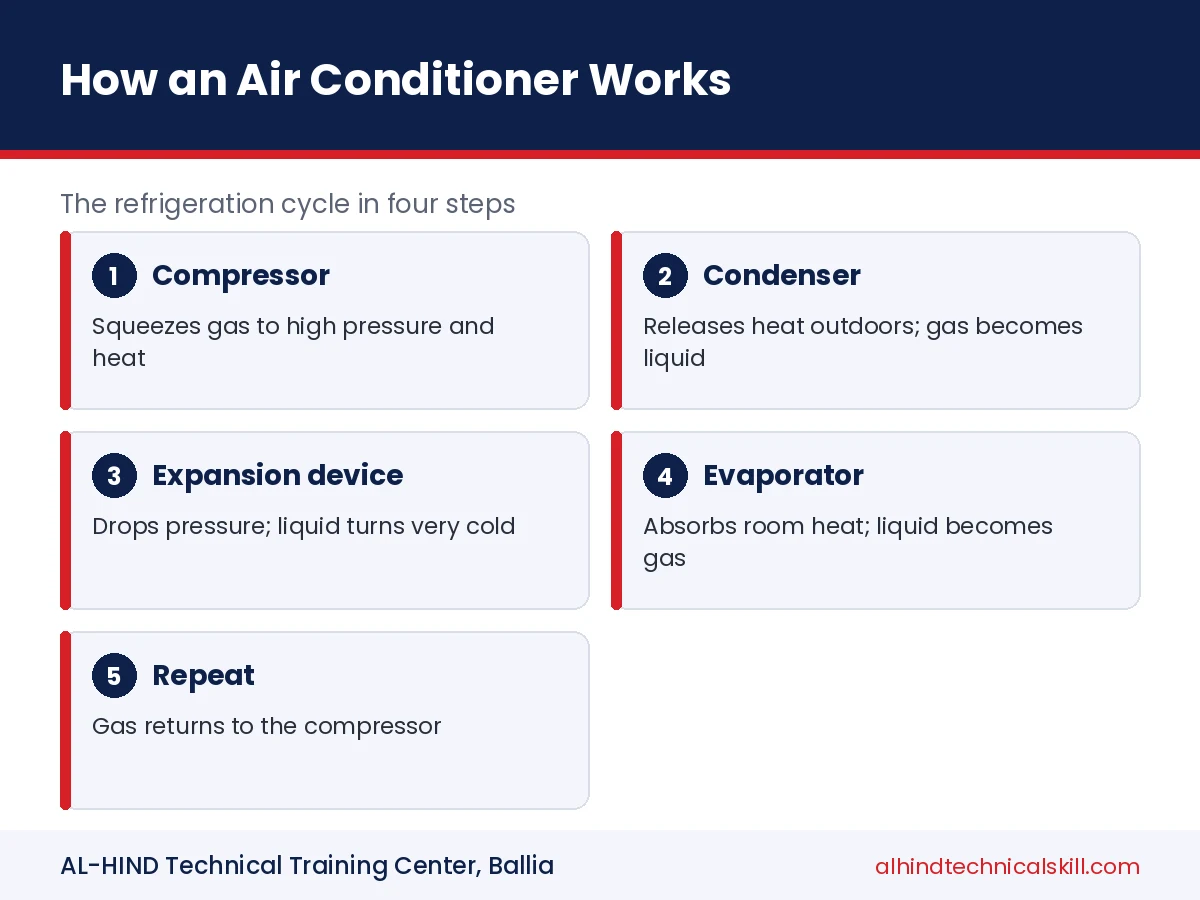
What are the four main parts: compressor, condenser, expansion device and evaporator?
Learn these four in order. They follow the path of the refrigerant.
| Part | Where it sits | What it does |
|---|---|---|
| Compressor | Outdoor unit | Pumps refrigerant gas and raises its pressure and temperature |
| Condenser coil | Outdoor unit, with a fan | Releases heat to the outside air; the gas turns to liquid |
| Expansion device (capillary tube or valve) | Between condenser and evaporator | Drops the pressure so the liquid becomes very cold |
| Evaporator coil | Indoor unit, with a blower | Absorbs heat from room air; liquid turns to gas |
Notice the names tell the story. The evaporator evaporates refrigerant, and the condenser condenses it. If you remember compressor, condenser, expansion, evaporator, you have the order of the cycle.
What happens step by step in the refrigeration cycle?
Follow one drop of refrigerant around the loop.
- The compressor takes in low-pressure gas and compresses it into hot, high-pressure gas.
- The hot gas moves to the condenser, where the outdoor fan blows air over the coil. The gas gives up heat and becomes liquid.
- The liquid passes through the expansion device. Pressure falls suddenly and the liquid becomes cold.
- In the evaporator, cold refrigerant absorbs heat from the room air and turns back into gas.
- The gas returns to the compressor, and the cycle starts again.
This is the core of how air conditioner works, and it is the refrigeration cycle that students study in AC and HVAC courses. A real unit also has controls, sensors and safety devices, but these four steps are the heart of the system.
Why does the outdoor unit blow hot air?
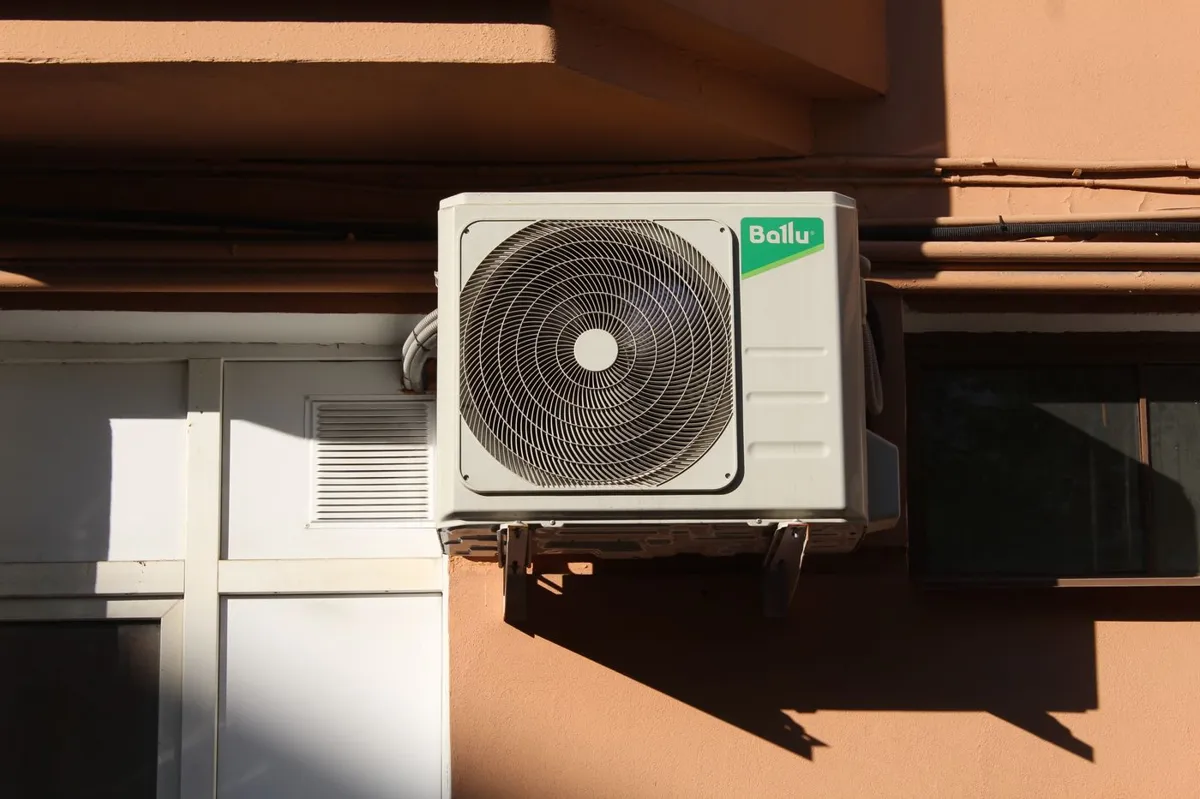
The outdoor unit is where the heat leaves the building. That hot air is the heat that was taken from your room plus the heat added by the compressor. So a warm outdoor unit is normal. Problems start if the outdoor coil is dirty or blocked, because the heat cannot escape well and the cooling drops.
This is also why an AC should never be boxed in by walls or stacked items, and why a clear space around the outdoor unit is a basic installation rule that technicians follow. Always follow the maker’s installation manual for exact clearances.
What are common AC problems that relate to the cycle?
Knowing how air conditioner works helps a technician think logically. Use this table as a starting point for study, not as a repair manual.
| Symptom | Possible cause linked to the cycle | First safe check |
|---|---|---|
| Weak cooling | Dirty filter or coil, low airflow, low refrigerant | Clean the filter as per the manual |
| Ice on indoor coil | Poor airflow or low refrigerant | Switch the AC off and call a technician |
| Outdoor fan not running | Capacitor, motor or wiring fault | Switch off power; trained person only |
| Water leaking indoors | Blocked drain pipe or tilted unit | Check the drain with power off |
| Compressor not starting | Electrical or control fault | Trained person only |
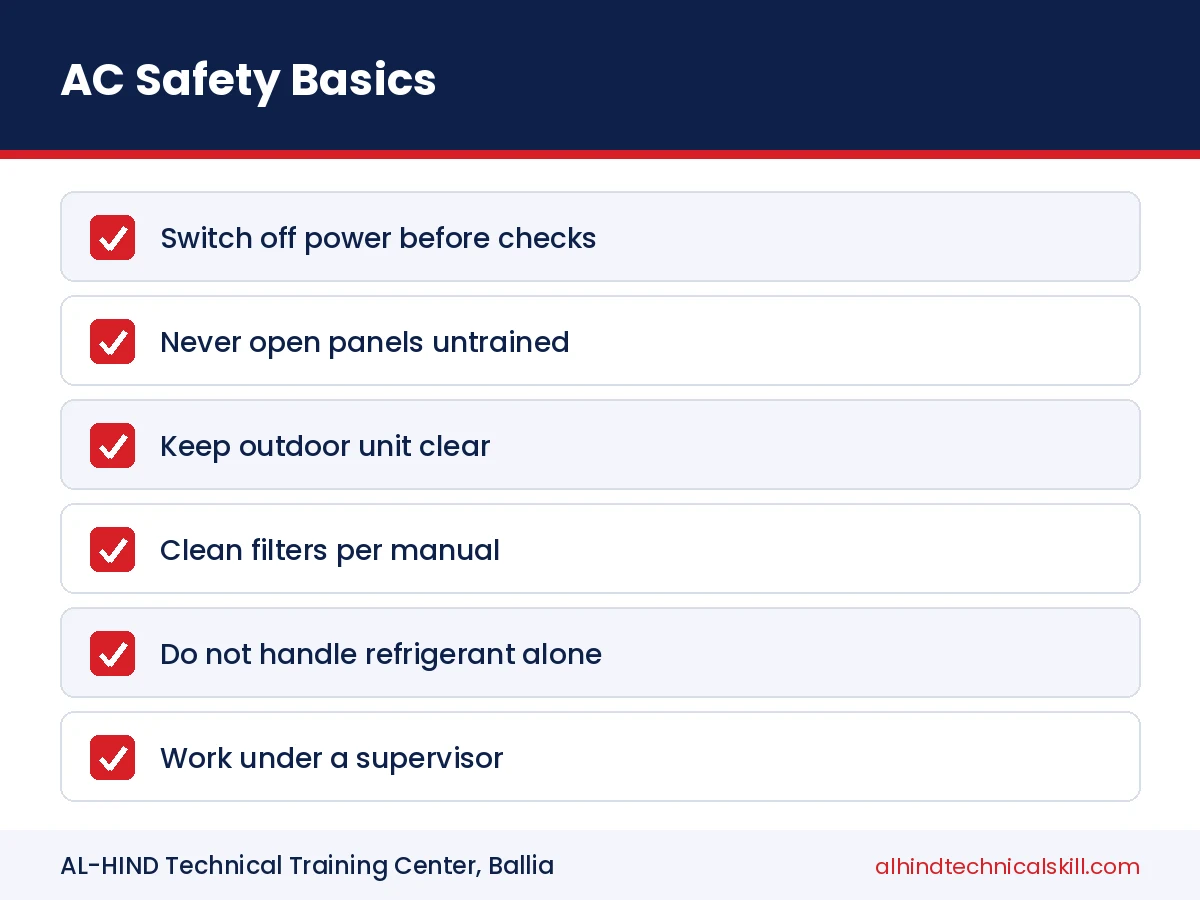
Do not open an AC panel or touch capacitors or wiring unless you are trained. Capacitors can hold charge, and refrigerant handling needs training, tools and care. Work only under a qualified supervisor.
Which skills do you need to become an AC technician?
A good AC technician combines three skills: basic electrical knowledge, refrigeration knowledge and careful practical habits. You should be able to read a wiring diagram, use a multimeter, flare and join copper pipes, test for leaks and work safely at height when installing outdoor units.
Learning path
- Learn the cycle and part names, as in this article.
- Practise tool use in a workshop with a trainer.
- Learn electrical safety and isolation.
- Learn installation, servicing and fault finding on real units.
- Keep a log of jobs you have done under supervision.
Read more on our AC technician course page and our overview of the HVAC course in Ballia. Electrical safety basics are in electrical safety rules for electricians.
Do star ratings and inverter technology change the cycle?
No, the basic cycle is the same. An inverter AC changes the compressor speed to match the load instead of switching it fully on and off, which can save energy. A higher BEE star label indicates better energy efficiency under the rating rules. When buying or advising customers, check the label on the unit and the maker’s documents instead of trusting verbal claims.
Why learn at Al-Hind Technical Training Center?
Al-Hind provides practical, hands-on technical training at its Ballia centre. Students who want to become AC and HVAC technicians can see how the refrigeration cycle looks in real equipment, with safety explained step by step. We also offer counselling on the Gulf job process, but we offer placement assistance and guidance, not guaranteed jobs. Check the courses or ask about training through the contact page.
Frequently asked questions
Does an air conditioner create cold air?
No. An AC moves heat from inside the room to the outside using refrigerant in a closed loop. The cold feeling comes from heat being removed from the room air as it passes over the cold indoor coil.
What is the refrigeration cycle in an AC?
It is the loop in which refrigerant is compressed, cooled to a liquid in the condenser, dropped in pressure by the expansion device, and then evaporated in the evaporator to absorb room heat. The gas then returns to the compressor and the cycle repeats.
What does the compressor do in an AC?
The compressor is the pump of the system. It draws in low-pressure refrigerant gas and compresses it to higher pressure and temperature so the condenser can release heat to the outside air. Without a working compressor, the cycle stops and the AC cannot cool.
Why is the outdoor unit of an AC hot?
Because it rejects the heat taken from your room, along with heat from the compressor. A warm outdoor unit is normal. If cooling is poor and the unit is very hot, the coil may be dirty or airflow blocked. Have a trained technician inspect it.
Can I refill AC gas myself?
No. Refrigerant handling needs training, tools and safety knowledge, and low gas usually means a leak that must be found and repaired. Call a qualified technician. Do not open panels or attempt electrical repairs without training.
Is AC technician work a good career after 10th or 12th?
It can be a practical trade for students who like hands-on work, but results depend on your skill, experience and local demand. Look for training with real equipment and safety teaching, and ignore anyone who promises a guaranteed job.
Conclusion
Now you know how air conditioner works: the compressor, condenser, expansion device and evaporator move heat from inside to outside in a continuous loop. Learn the cycle first, then practise on real equipment with a trainer.
Interested in AC and HVAC training? Call or WhatsApp 7393017040 or 7860262615, or visit the centre at Umargang Gawar Road, near Bank of Baroda, Ballia, Uttar Pradesh 277001.