An electrician tools list for beginners starts with a few reliable hand tools and two testing instruments: insulated screwdrivers, pliers, a wire stripper, a line tester, a multimeter and some basics like tape and a measuring tape. Good tools make work neater and safer, but no tool replaces training. Use all of them only under a qualified supervisor until you are trained.
Key Takeaways
- Start with hand tools you will use every day, then add testing tools.
- Choose insulated tools made for electrical work and check them before each use.
- A multimeter and a voltage tester help you confirm that a circuit is dead before touching it.
- Buy quality over quantity. A small, good kit beats a big cheap one.
- Tools do not make you safe; correct method and supervision do.
What is on a basic electrician tools list for beginners?
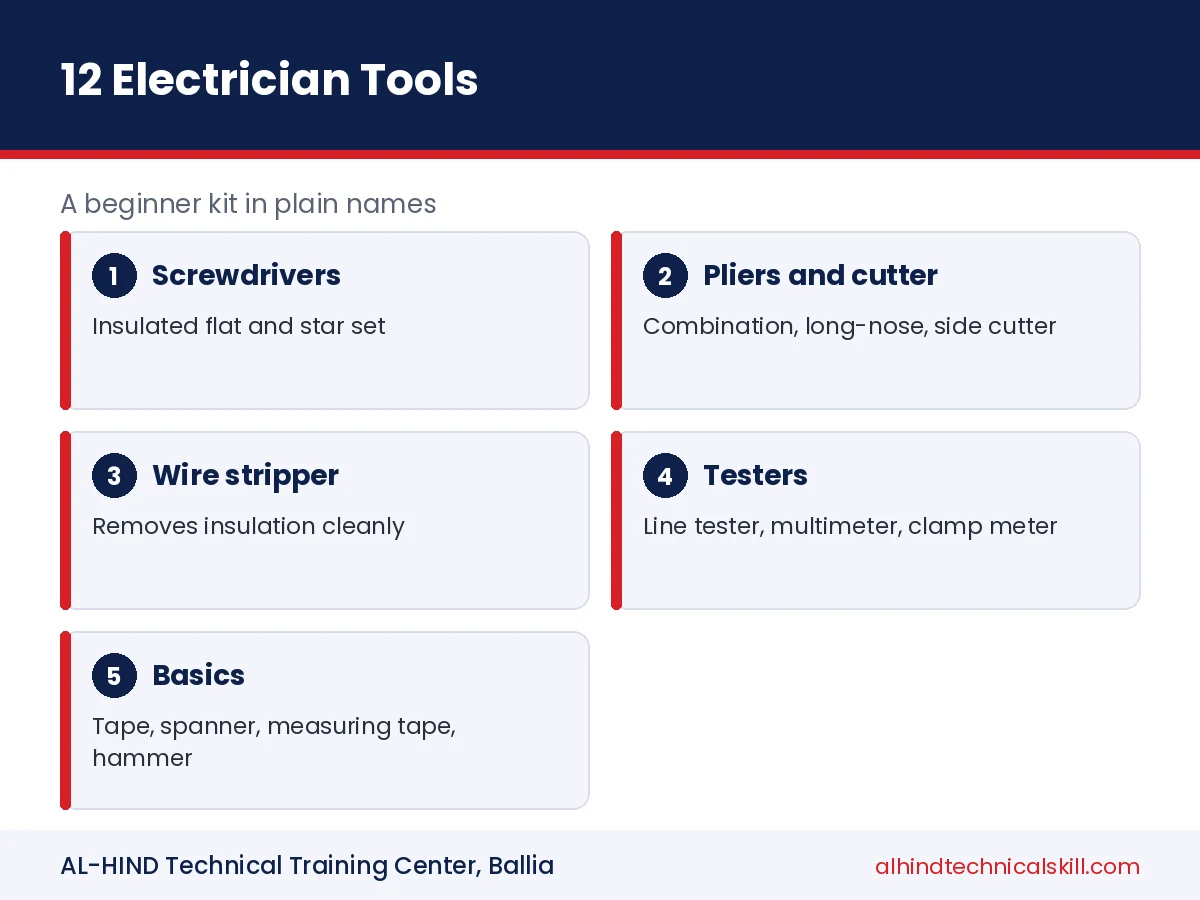
Learn the names first, because trainers and shop owners use them all day. Here are 12 basic electrician tools that most beginners meet in the first weeks of training.
| No. | Tool | Main use |
|---|---|---|
| 1 | Insulated screwdriver set (flat and star) | Tightening terminals, switches, sockets |
| 2 | Combination pliers | Gripping, bending and cutting wire |
| 3 | Long-nose pliers | Reaching and shaping wire in tight places |
| 4 | Side cutter (diagonal cutter) | Cutting wires cleanly |
| 5 | Wire stripper | Removing insulation without nicking the copper |
| 6 | Line tester or voltage tester | Checking if a point is live |
| 7 | Digital multimeter | Measuring voltage, continuity and resistance |
| 8 | Clamp meter | Measuring current without opening the circuit |
| 9 | Insulation tape | Covering joints as per good practice |
| 10 | Adjustable spanner | Tightening nuts and bolts |
| 11 | Measuring tape | Marking cable runs and positions |
| 12 | Hammer and chisel set | Making chases and fixing clamps |
A tool bag, a torch and safety gear complete the kit.
How do you use the main hand tools correctly?
Correct use matters as much as the tool. These habits are standard in good training.
Screwdrivers and pliers
Use a screwdriver that fits the screw head, so it does not slip. Insulated handles help, but they do not make a live circuit safe. Switch off and isolate before you work. Use pliers to grip and cut, not as a hammer.
Wire stripper and cutter
Choose the correct slot for the wire size, so the strands are not cut. A damaged conductor can heat up later. Cut cleanly and avoid pulling the wire at an angle.
Measuring tape and spanners
Measure twice and cut once. Use the right spanner size and avoid extending handles with pipes, which can slip and cause injury.
Our electrician course in Ballia page explains how practical training covers these skills.
What testing tools are most important for safety?
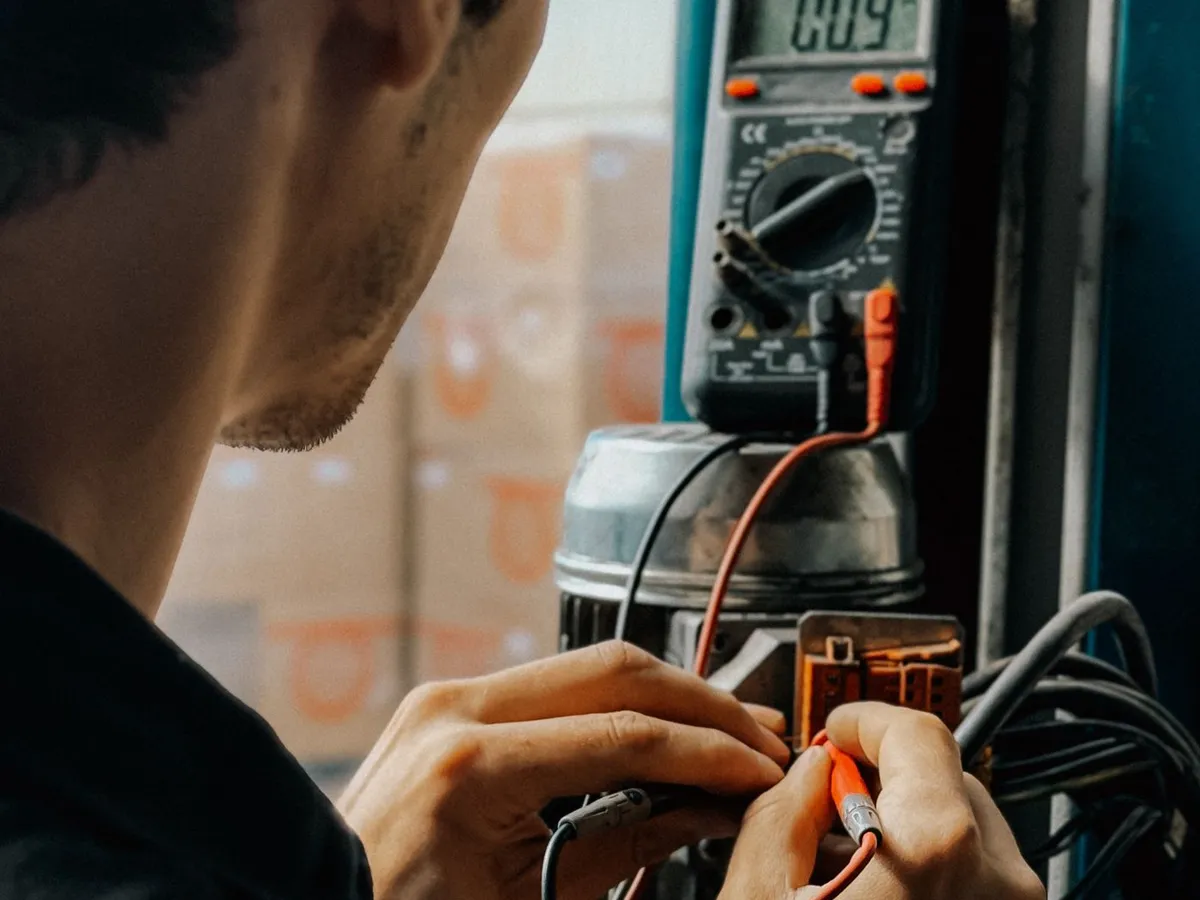
Testers are the tools that help you check, not guess. A line tester gives a quick sign of a live point, and a digital multimeter gives numbers for voltage, continuity and resistance. A clamp meter measures current by clamping around one conductor.
| Instrument | What it tells you | Beginner caution |
|---|---|---|
| Line tester | Whether a point appears live | Not enough alone; confirm with a proper meter |
| Digital multimeter | Voltage, continuity, resistance | Select the correct range and function before probing |
| Clamp meter | Current in a single conductor | Clamp one conductor, not the whole cable |
Never trust a single indication. Isolate, test, and test again as your trainer teaches. Read the electrical safety rules for electricians before you use any tester on site. Work only under a qualified supervisor.
Which safety gear should go with your electrician tools?
An electrician tools list is not complete without safety gear. Tools are only part of the kit. Personal protective equipment, or PPE, protects you if something goes wrong.
- Safety shoes with insulating soles, as suited to the site.
- Insulated gloves where the work requires them, used as per training.
- Safety helmet on construction sites.
- Safety glasses when drilling or cutting.
- A torch or headlamp for dark spaces.
- A basic first-aid kit nearby.
If someone gets an electric shock, do not touch them while the supply is on. Switch off the power first if you can do so safely, then call 108 or 112 for an ambulance. Learn first aid in training so you can act calmly.
How do you build a starter tool kit without wasting money?
Use the electrician tools list above as a guide. Buy slowly and learn each tool before buying the next. We cannot give prices because they change by brand and city.
- Begin with screwdrivers, pliers, a stripper and a tester.
- Add a good digital multimeter once you understand its settings.
- Buy insulated tools from a reliable shop and check markings and finish.
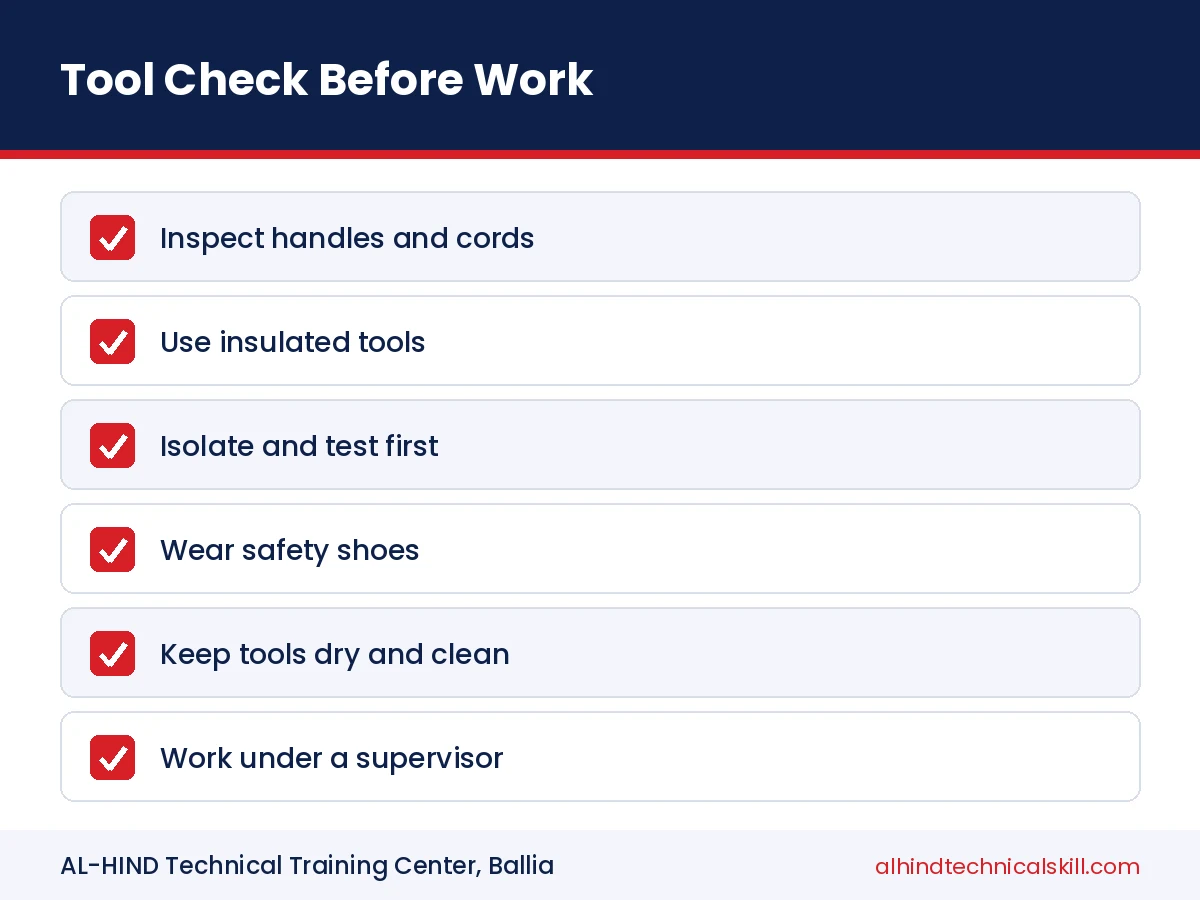
- Inspect cords and handles for cracks before each use.
- Keep tools clean and dry in a bag, not loose.
- Ask your trainer which items you need first.
Some institutes provide workshop tools for training, so ask what you must bring yourself before you buy anything.
How do you take care of your tools?
Maintenance is part of the trade. Wipe tools after use, store them dry, and replace cracked insulation or damaged plugs at once. Never use a tool with a broken handle on a live job. Label your tools or mark them so they do not get mixed up on a shared site. Keep a small checklist of your kit and review it every week. Regular care keeps tools accurate and helps you work safely and neatly.
What comes after these 12 tools?
As you grow, you will meet a drill machine, a conduit bender, a megger for insulation testing and special tools for panels and motors. Learn each one with a trainer, because some are used on higher-risk jobs. You will also learn about wiring methods, earthing and testing in the electrician course syllabus. If you wish to work in the Gulf later, employers may check practical use of tools in a trade test. See the Gulf trade test guide for what to expect.
Why learn at Al-Hind Technical Training Center?
At Al-Hind, practical training at the Ballia centre means students learn to recognise and use tools in a workshop, with safety taught alongside. We also offer counselling about the Gulf job process, but only placement assistance and guidance, never a guaranteed job. Look at our courses, read the placement assistance details or contact us to visit the workshop.
Frequently asked questions
What is the basic electrician tools list?
A basic list includes insulated screwdrivers, combination pliers, long-nose pliers, a side cutter, a wire stripper, a line tester, a digital multimeter, a clamp meter, insulation tape, an adjustable spanner, a measuring tape, and a hammer and chisel set.
Which tool should a beginner electrician buy first?
Start with a good insulated screwdriver set, combination pliers, a wire stripper and a line tester. Add a multimeter when you understand how to use it. Ask your trainer for advice, because needs differ by the type of work you will do.
Is a multimeter necessary for an electrician?
Yes, it is one of the most useful testing tools. It measures voltage, continuity and resistance. However, you must select the right setting and follow safety steps. Use it as taught by a trainer and always isolate the supply before working on a circuit.
What is the difference between a multimeter and a clamp meter?
A multimeter uses probes to measure voltage, continuity and resistance. A clamp meter clamps around a single conductor to measure current without breaking the circuit. Many clamp meters also measure voltage. Both need correct use and care.
Are insulated tools enough to make electrical work safe?
No. Insulated tools add protection, but they do not make live work safe. Always switch off, isolate and test before work, use proper PPE, follow site rules and work only under a qualified supervisor. Never rely on one safety measure alone.
Do I need to buy all tools before joining a course?
Not necessarily. Many institutes provide workshop tools for practice. Ask what is supplied and what you should bring, and get this in writing. Do not buy a large kit in advance on an agent’s advice.
Conclusion
This electrician tools list gives you a clear, practical start: learn the 12 tools, add safety gear and use everything under a qualified supervisor. Buy slowly, care for your tools and keep learning.
Want to see these tools used in a workshop? Call or WhatsApp 7393017040 or 7860262615, or visit the centre at Umargang Gawar Road, near Bank of Baroda, Ballia, Uttar Pradesh 277001.