A pipe fitter training syllabus usually covers safety, tools, reading drawings, pipes and fittings, joints, supports and testing, with most time spent in the workshop. Exact subjects vary by institute, so ask for the written plan before joining.
Key Takeaways
- A pipe fitter training syllabus should mix theory with plenty of workshop practice.
- Drawing reading is a core skill that employers often test.
- Know common fittings: elbows, tees, reducers, unions, flanges and valves.
- Welding and pressure testing must be done only under a qualified instructor.
- Training builds skill but never guarantees a job or visa.
What does a pipe fitter training syllabus usually include?
A pipe fitter training syllabus usually covers drawings, pipe and fittings knowledge, hand and power tools, joining methods, testing and safety. Exact subjects and hours differ between institutes, so ask any centre for its written syllabus before you join.
A good syllabus balances theory and practice. You need to understand why a pipe system is built a certain way, but employers mostly test what your hands can do. Expect to spend most of your time in the workshop measuring, cutting, threading, fitting and testing real pipe.
The list below is a general guide to topics often taught in pipe fitter courses. It is not the fixed syllabus of any one institute. See our pipe fitter course in Ballia page for course details and ask the centre for its current plan.
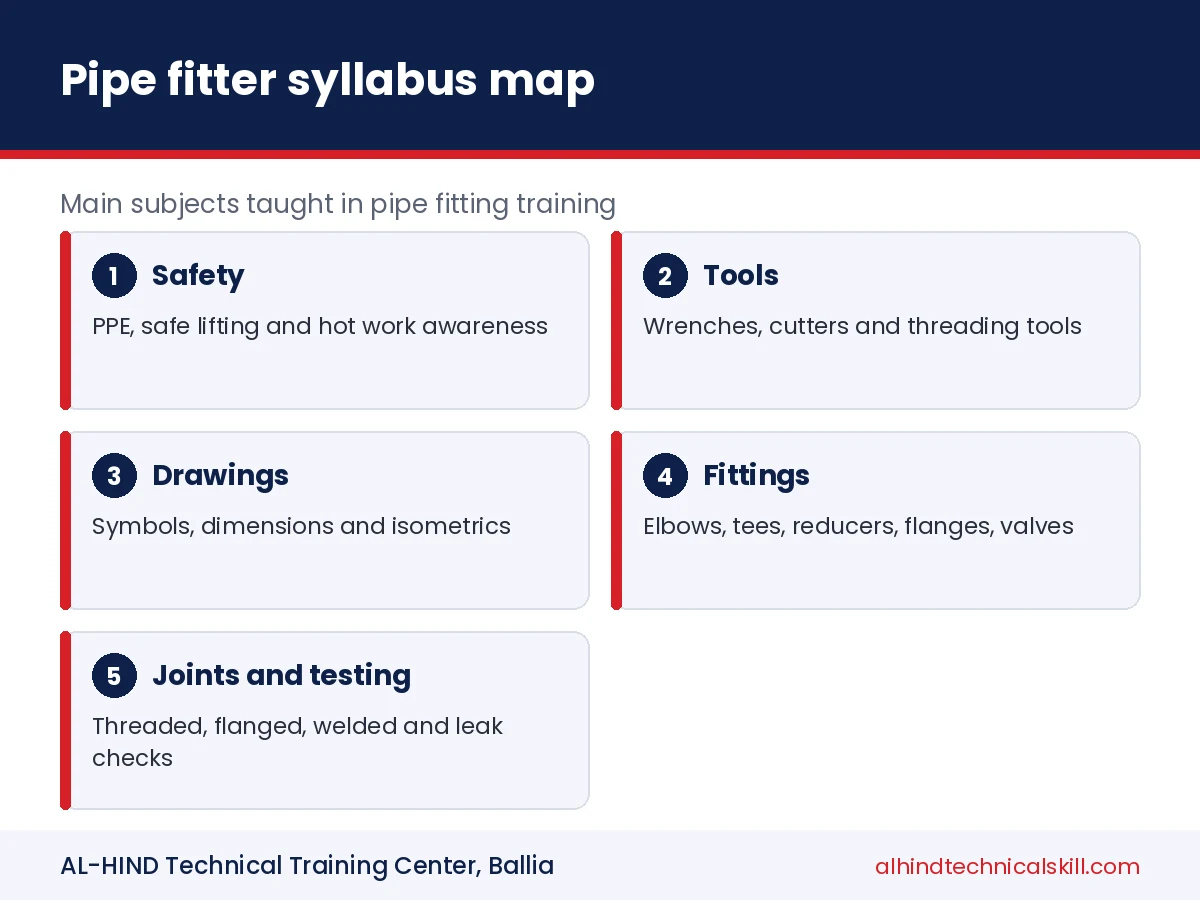
Which subjects form the core of pipe fitter course subjects?
The core subjects are workshop safety, trade tools, reading drawings, pipe and fitting types, joints, supports and testing. The table shows how each subject is usually linked to practical work.
| Subject | What you learn | Practical work |
|---|---|---|
| Safety and PPE | Hazards, safe lifting, hot work awareness | Wearing and checking PPE, housekeeping |
| Measuring and marking | Tape, level, square, plumb line, marking pipe | Marking cut lengths and fitting positions |
| Tools | Pipe wrench, cutters, threading tools, spanners | Cutting and threading practice pieces |
| Pipes and materials | Types of pipe such as steel, GI, PVC and copper, and their uses | Identifying pipes by size and material |
| Fittings and valves | Elbows, tees, reducers, unions, flanges, valve types | Assembling a small pipe run |
| Drawings | Symbols, isometric views, dimensions | Fabricating from a simple drawing |
| Joints | Threaded, flanged and welded joints | Making and checking joints |
| Testing | Leak and pressure testing basics | Observing or assisting a test under supervision |
How important are drawings in pipe fitting?
Drawings are extremely important, because pipe fitters build systems from drawings, not from memory. Learning to read symbols, dimensions and isometric sketches is one of the most valuable skills a trainee can build.
An isometric drawing shows a pipe run in a three-dimensional style so you can see turns, lengths and fittings. A fitter reads it to cut pipe to the right length and place elbows and valves correctly. Employers often ask candidates to explain a simple drawing in interviews or trade tests, so practise reading one every week.
What drawing skills should you practise?
- Recognising common symbols for valves, flanges and reducers
- Reading dimensions and notes
- Understanding nominal pipe size and the idea of pipe schedule (wall thickness)
- Following a flow direction on a layout
- Making a simple material list from a drawing

Which fittings and joints should a pipe fitter know?
A pipe fitter should know common fittings, such as elbows, tees, couplings, reducers, unions and flanges, and common joint types: threaded, flanged and welded. Each fitting changes the direction, size or connection of a pipe run.
- Elbow: changes direction of the pipe.
- Tee: creates a branch.
- Reducer: joins pipes of different sizes.
- Union: lets you open a joint for maintenance.
- Flange: a bolted connection with a gasket.
- Valve: starts, stops or controls flow.
In training, you learn how to select the right fitting and how to assemble it so it does not leak. Flange work includes aligning faces, placing the gasket and tightening bolts in a proper pattern. Welded joints need welding skill and strict safety, so these are done only under a qualified instructor. Read our guide to welding safety rules before any hot work.
What practical work should you expect in pipe fitter training?
You should expect regular workshop sessions where you measure, cut, thread, fit and test small pipe assemblies. Practical work is where skill is built, so ask the institute how many sessions you get and whether each student handles the tools personally.
- Marking and cutting pipe to length.
- Threading pipe ends and making threaded joints.
- Building a small pipe run from a drawing.
- Fitting valves and flanges correctly.
- Supporting pipe and checking alignment and slope.
- Leak testing the assembly under supervision and fixing faults.
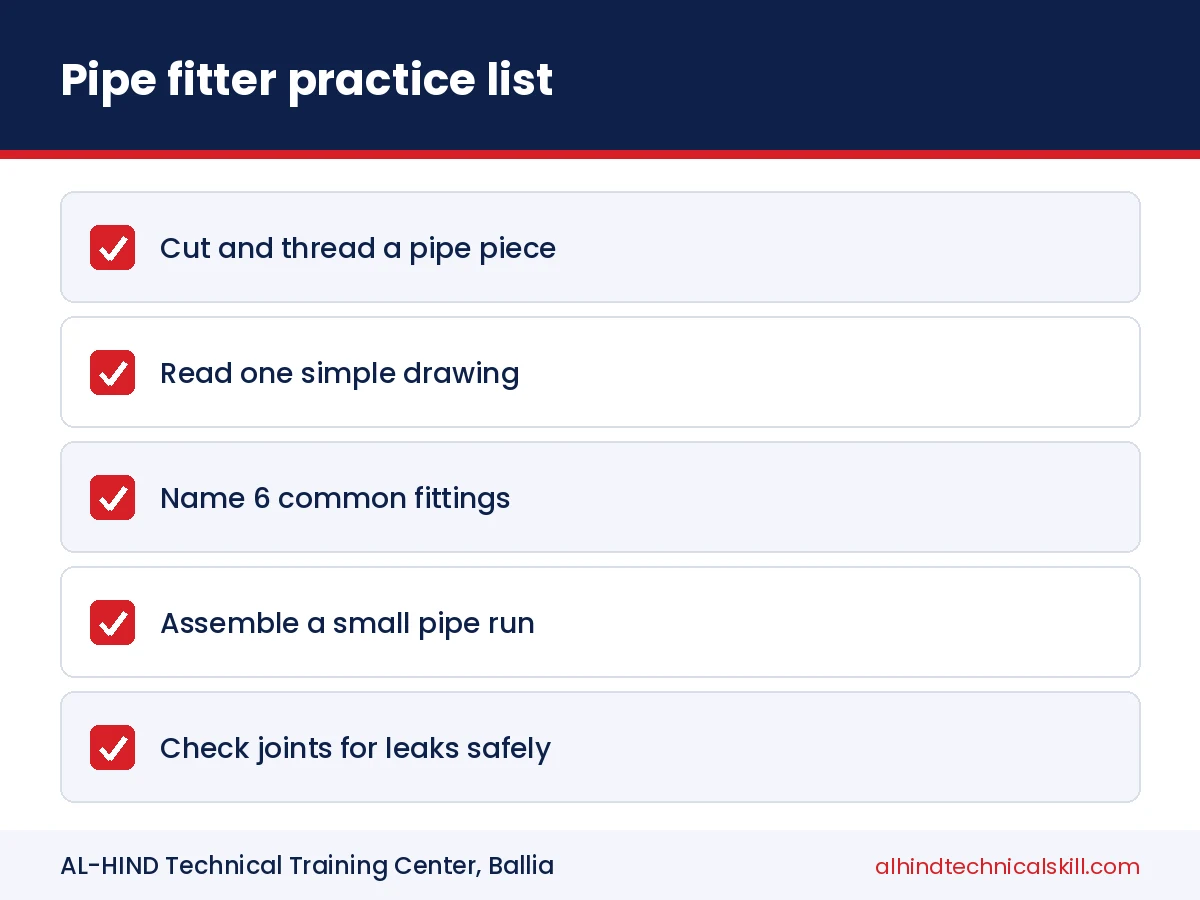
Keep a notebook of what you practised, with simple sketches. It helps you remember and can help when you describe your skills to an employer. Always work under a qualified instructor when testing under pressure, because stored pressure can injure people if a joint fails.
How does pipe fitter training connect to Gulf jobs?
Gulf employers in construction, oil and gas, and industry often hire pipe fitters, but they check skill, experience and documents, and often hold a trade test. A solid syllabus gives you the base to perform in that test. It does not guarantee any job or visa.
Learn the English names of tools and fittings, practise drawing reading, and learn site safety. Our Gulf trade test guide explains how skill is checked, and the Gulf jobs country guide compares countries. For safe applications, follow the official process on the eMigrate portal and verify any recruiter first.
What should you ask before joining a pipe fitting course?
Ask for the written syllabus, the number of practical sessions, the tools available, and what certificate you will get. Visit the workshop. Be careful of a centre that talks only about jobs and visas but shows no practical area. You can also see other options in our course list.
Why learn at Al-Hind Technical Training Center?
Al-Hind Technical Training Center in Ballia focuses on practical technical training, so students handle tools and learn safe habits rather than only reading notes. We also provide counselling and guidance on the Gulf job process, and our placement assistance is support and guidance, not a guarantee. Learn more on our pipe fitter course page, browse all courses, or see how to join on the admission page.
Frequently asked questions
What subjects are in a pipe fitter course?
Common subjects include workshop safety, tools, measuring, pipe and fitting types, drawings, joints, supports and testing. The exact list differs by institute, so ask for the written syllabus. Practical workshop sessions are the most important part of any pipe fitter course.
Do pipe fitters need to read drawings?
Yes. Pipe fitters work from drawings that show size, length, fittings and flow direction. Learning symbols and isometric views is a core skill, and employers often test it. Practise reading simple drawings regularly during training.
Is welding part of pipe fitter training?
Some courses include basic welding awareness or separate welding training, while others focus on fitting only. Welding must be done only under a qualified instructor with correct PPE. Ask the centre exactly what is taught so you know what to expect.
How long is a pipe fitter course?
Duration differs between institutes and programmes, so there is no single answer. Ask the centre for the schedule in writing and compare it with the syllabus. Judge a course by the practical work it offers, not only by its length.
Can a pipe fitter get a job in the Gulf after training?
Training helps you build skill, but employers also check experience, documents and often a trade test, and no centre can guarantee a job. Prepare well, verify every offer and use the official eMigrate and Ministry of External Affairs guidance.
What tools should a pipe fitter trainee know?
Trainees should know pipe wrenches, cutters, threading tools, spanners, measuring tape, spirit level and marking tools, plus basic power tools under supervision. Learn their English names and safe use. Good tool habits impress trainers and employers.
Conclusion
A strong pipe fitter training syllabus covers safety, tools, drawings, fittings, joints and testing, with plenty of workshop practice. Ask for the written plan, see the workshop, and judge the course by the practical work you will do.
To learn more about hands-on pipe fitting training in Ballia, Call or WhatsApp 7393017040 or 7860262615, or visit the centre at Umargang Gawar Road, near Bank of Baroda, Ballia, Uttar Pradesh 277001.