Lockout tagout basics start with one rule: isolate the energy, lock it, tag it, release stored energy and test that it is dead before you touch it. Electricians use LOTO to stop equipment being switched on during work. Always follow site procedure and work under a qualified supervisor.
Key Takeaways
- Lockout tagout basics: isolate, lock, tag, release stored energy, test.
- Each worker uses a personal lock and removes only their own lock.
- A lock is stronger than a tag; a tag alone is only a warning.
- Stored energy can remain after power is switched off.
- Work only under a qualified supervisor and follow the site procedure.
What is lockout tagout and why do electricians need it?
Lockout tagout (LOTO) is a safety procedure that makes sure a machine or circuit is switched off, isolated and cannot be turned on again while someone is working on it. Electricians need lockout tagout basics because a circuit that is “off” can be switched back on by mistake, and that can kill.
The idea is simple. Before work starts, you isolate every source of energy, put your own personal lock on the isolation point, attach a tag that says who is working and why, and then prove the equipment is dead. Only the person who put the lock on removes it. OSHA describes lockout and tagout as part of its control of hazardous energy rules, which many employers and sites around the world also use as a model.
Always work only under a qualified supervisor and follow your site’s own written procedure, because each site has its own rules.
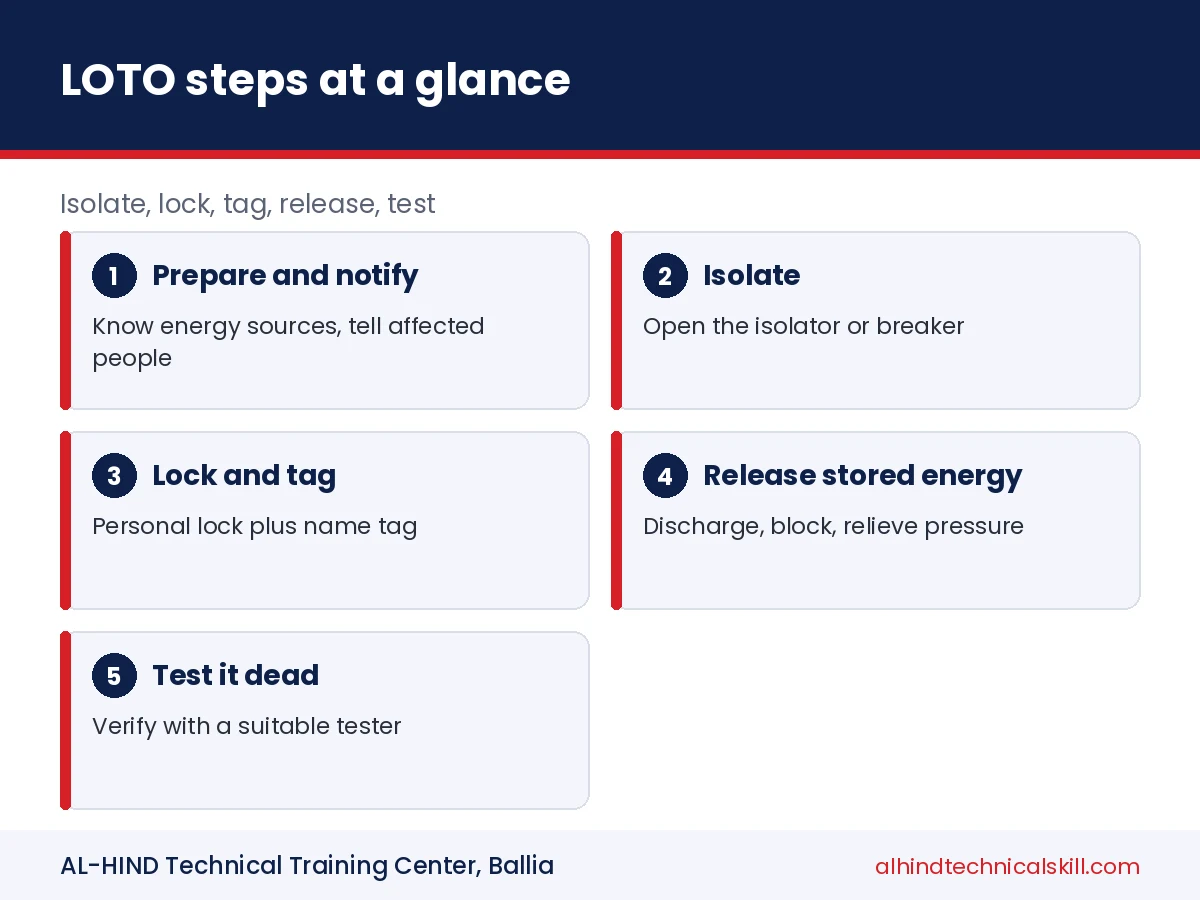
What are the lockout tagout basics for electricians (LOTO steps)?
The basic LOTO steps are: prepare, notify, shut down, isolate, lock and tag, release stored energy, and verify that the equipment is dead. Only after verification can work begin. The table gives a simple outline.
| Step | What you do | Why |
|---|---|---|
| 1. Prepare | Learn the equipment and all energy sources | You cannot isolate what you do not know |
| 2. Notify | Tell affected people the equipment will be off | No one should be surprised |
| 3. Shut down | Stop the equipment the normal way | Avoids sudden shocks to the system |
| 4. Isolate | Open the isolator, breaker or switch | Cuts the energy source |
| 5. Lock and tag | Fit your personal lock and tag | Stops others from switching on |
| 6. Release stored energy | Discharge capacitors, release springs and pressure, block moving parts | Energy can remain after power is off |
| 7. Verify | Test that the circuit is dead with a suitable tester | Proves isolation worked |
What does “test before touch” mean?
It means you prove the circuit is dead using a suitable tester before you put your hands on it. First check that your tester works on a known live source, test the circuit, then check the tester again if your procedure requires it. Never assume a circuit is dead because a switch looks off.
What is the difference between a lock and a tag?
A lock physically prevents the isolation device from being operated, while a tag is a warning label that says who put it there and why. A lock is stronger. A tag alone relies on people reading and obeying it.
Each worker should use their own lock with a key that only they hold. If several people work on the same equipment, each fits a personal lock, often on a multi-lock hasp. The tag should include the name, date and reason, and say not to operate the device. Sites may use group lockout rules, but those follow written procedures set by competent persons.
Why does stored energy matter in LOTO?
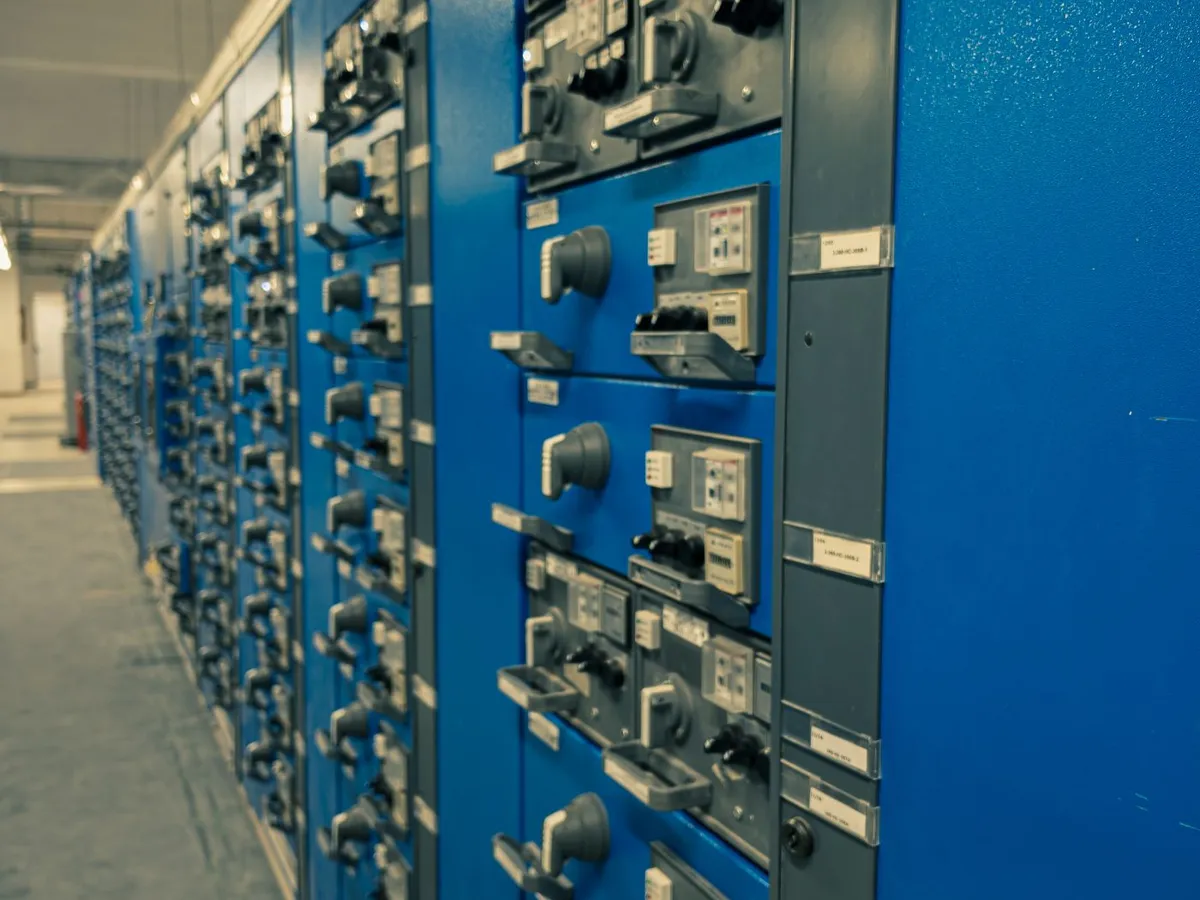
Stored energy matters because equipment can still hold dangerous energy after the power is switched off. Capacitors can hold an electric charge, springs can release suddenly, and pipes can hold pressure. Isolation must cover all of these.
- Electrical: capacitors and long cables can keep a charge.
- Mechanical: flywheels, springs and raised parts can move.
- Hydraulic and pneumatic: pressure can remain in lines.
- Thermal: hot surfaces and steam can burn.
- Gravity: raised loads can fall.
Learn the energy sources of every machine you work on, and follow the site’s procedure to release or block each one safely. Our guide to electrical safety rules for electricians adds more on isolation and testing.
How do you restore power safely after the work?
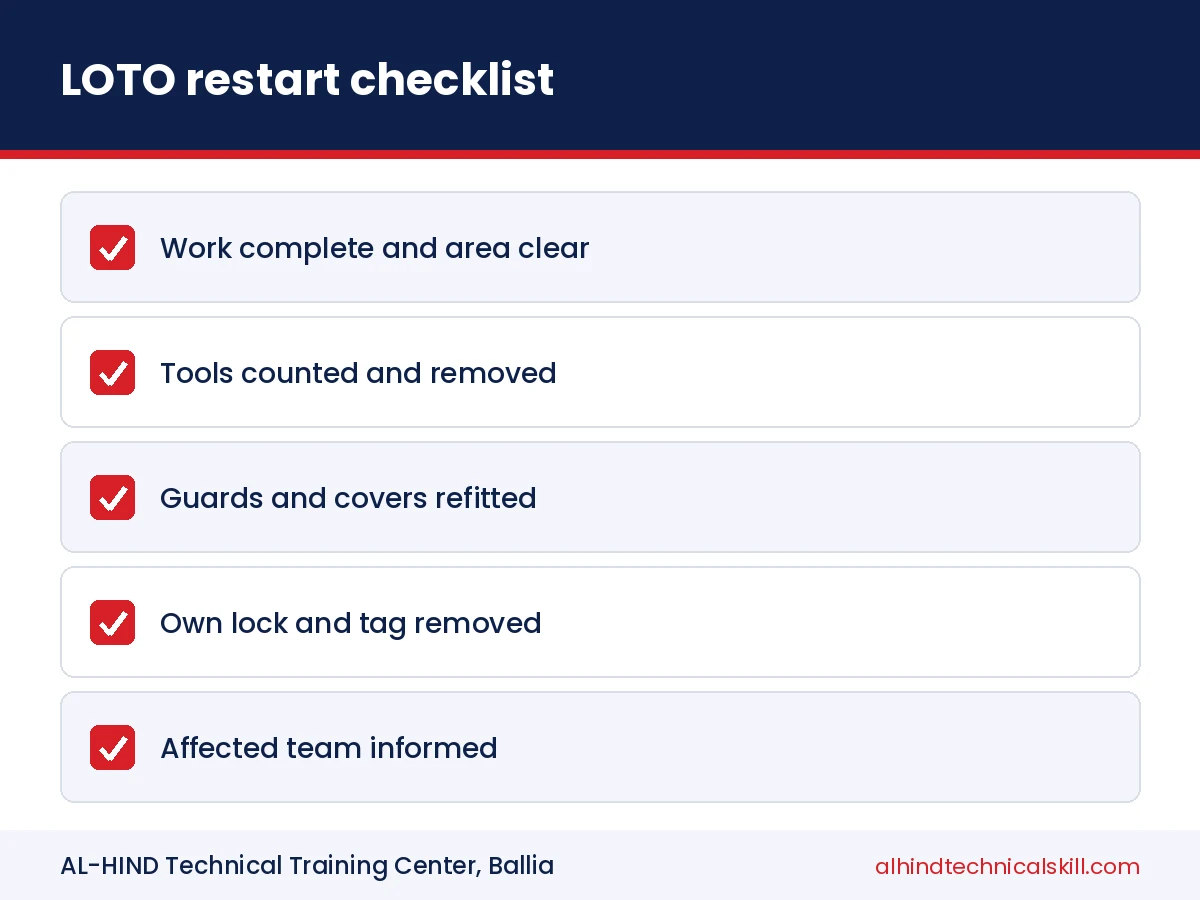
Restore power only after the work is finished, tools and materials are cleared, guards are back, and everyone is clear of the equipment. The person who applied the lock removes it, and affected people are told before power returns.
- Check the work is complete and nothing is left inside the equipment.
- Count tools and remove loose items.
- Refit covers and guards.
- Make sure all people are clear.
- Each person removes only their own lock and tag.
- Tell the affected team, then re-energise as per the site procedure.
If a lock owner is not available, never cut the lock yourself. Follow the site procedure, which normally needs a supervisor to verify that the person is safe and informed.
What mistakes make LOTO fail?
LOTO fails when people skip steps, share locks, trust a tag alone, forget stored energy or do not test. Most of these come from hurry and habit.
- Skipping the test because “I just saw it switched off”.
- Using someone else’s lock or leaving a lock for a colleague to remove.
- Switching off a control button instead of the isolator.
- Working on one machine while a neighbour machine feeds it.
- Not telling the night shift about locks still on.
If someone is shocked, do not touch them if they may still be in contact with power. Switch off the supply if it is safe to do so, then call 108 for an ambulance or 112. Only trained people should give first aid such as CPR. Read about the right gear in our post on PPE for technicians.
How does LOTO knowledge help in Gulf jobs?
Gulf sites, especially industrial and oil and gas sites, usually have strict permit and isolation systems. Employers may ask technicians how they would isolate and test equipment, so knowing LOTO basics improves your interview and trade test answers. It does not guarantee a job.
Check our list of interview questions for technicians and the electrician course in Ballia page. When you plan overseas work, verify every offer on the official eMigrate portal and avoid paying unverified agents.
Why learn at Al-Hind Technical Training Center?
Al-Hind Technical Training Center in Ballia teaches practical technical skills with safe working habits from the start, including isolation and testing awareness under instructor supervision. We also offer counselling on the Gulf job process, and our placement assistance is guidance only, never a guarantee. Explore our courses, the safety course, or the admission page.
Frequently asked questions
What is lockout tagout in simple words?
Lockout tagout is a method to make sure equipment is switched off, isolated and cannot be restarted while someone works on it. You fit your own lock and a warning tag on the isolation point, then test that the equipment is dead before starting.
What are the steps of LOTO?
The basic steps are prepare, notify affected people, shut down, isolate, lock and tag, release stored energy, and verify that the equipment is dead. After the work, clear tools, refit guards, remove your own lock and restore power as per the site procedure.
Why should each worker use their own lock?
Each worker’s personal lock protects that worker. If all locks are not removed, power cannot return. If one shared lock were used, one person could remove it while others are still working. Only the person who fitted the lock should remove it.
Is a tag enough without a lock?
A tag alone is only a warning and depends on people obeying it, so it is weaker than a lock. Sites normally use locks where equipment can be locked, with tags to show who is working. Follow your site’s written procedure and supervisor.
What should I do if someone is shocked at work?
Do not touch the person if they may still be in contact with live power. Switch off the supply safely if you can, then call 108 for an ambulance or 112. Only trained people should give first aid such as CPR.
Can a beginner do LOTO alone?
A beginner should learn LOTO and work only under a qualified supervisor, following the site’s written procedure. Training teaches the steps, testing and stored energy. Never isolate or test equipment alone until you have been trained and authorised.
Conclusion
Learning lockout tagout basics gives every electrician a habit that saves lives: isolate, lock, tag, release stored energy, test, and only then start work. Follow your site’s written procedure and work under a qualified supervisor.
To learn practical electrical work with safe habits in Ballia, Call or WhatsApp 7393017040 or 7860262615, or visit the centre at Umargang Gawar Road, near Bank of Baroda, Ballia, Uttar Pradesh 277001.